

Voice Memos
On Ben Lerner's "Transcription"

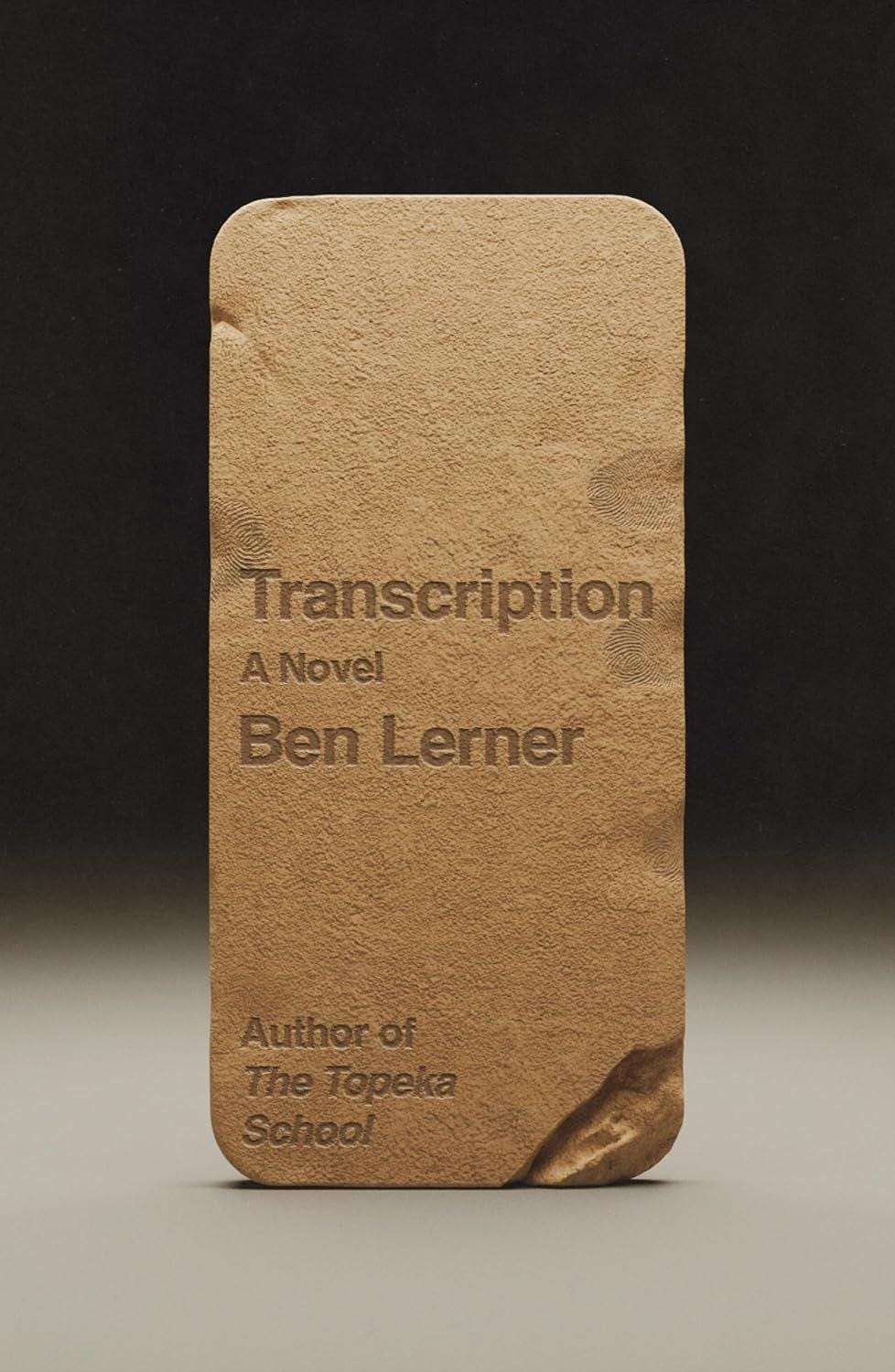
If I wanted to write one of those cheeky capsule reviews you see in small magazines — the last place where you can get close to a dollar per word — I’d just say: With Transcription, Ben Lerner has written a Rachel Cusk book. A somewhat removed autofictional narrator — this time we don’t even know if it’s Lerner’s roman a clef “Adam Gordon” from his previous novels, as he remains unnamed — long dialogues, a concatenation of constructed narratives somewhat about their own construction. Absent Cusk’s feminist project in the Outline novels — the retaking of subjective authority by women in a world shaped by men’s framing — we have in Transcription an exploration of aesthetic and intellectual pleasure of conversing and creating fiction itself. Second attempt at a pithy review: Like Katie Kitamura’s Audition, Ben Lerner’s Transcription is a slippery text about fictive authenticity that’s more interesting to think about than it is to actually read. Both texts introduce an instability in their conceit that makes establishing a base ‘reality’ of the novel difficult if not impossible, before ultimately concluding that the effect of the narrative is more important than whatever grounding it stands on. Third attempt at Twitter-screenshotted-semi-viral-mini-review (editors, take note, look at this range! I could go all day!): With Transcription, Ben Lerner has written a W.G. Sebald novel about Brooklyn-dad liberal flashpoints (authenticity, phone addiction, parenting styles, the COVID-19 pandemic) rather than the violent erasure of memory and premodern history. If Sebald’s novels presented a man out of time, haunted by the ghosts of Europe, Lerner’s ruminating narrator is thoroughly enmeshed in the present; the only ghosts of the past that emerge for him are from his own life, a narrow field of memory appropriate to the current vogue of (self) reflection (when it’s off, your phone is a mirror, dunno if anyone’s ever mentioned that before). Though some bits with Thomas wade into the kind of historico-intellecutal associative connections that Sebald liked to make across time, most of it is simply in thrall to the pleasure of the human voice and the attempts at its rendering, or, its Transcription. If you think that wordplay is kind of a corny highfalutin construction, you’ve been duly warned: that is exactly the kind of construction Lerner likes to make, faux-profundity wrestled out of the incongruousness of the contemporary world and the life of the mind.
Transcription is split into three sections, each named after a different hotel, each involving some kind of dialogue. In the first, the narrator travels from New York to Providence to interview his college mentor, Thomas, for a Paris Review-style interview. At his hotel, he drops his phone in the sink, his only means of recording the interview, and heads to Thomas’s home hoping to forestall the interview till he can get it replaced. For a number of narratively convenient reasons (Adrian Nathan West pointed out the flimsiness of this premise in The Baffler) the narrator can’t bring himself to admit that he’s not recording the interview, so after some hemming and hawing, they begin ‘really’ talking, and you, the reader, are aware that all this conversation is in the realm of reconstructing the real, no longer tethered to the constraints of life as it ‘actually’ happened. Well, in the slim second part — more of an interlude — we discover that some people don’t love the narrator’s use of creative license; some time later, at a conference held in Thomas’s honor in Madrid, he admits to his recording gaffe, sullying what many thought was Thomas’s last interview and leading to a low-stakes confrontation with one of his friends. Most printed interviews are constructions anyway, or so the narrator contends, but there is plenty of difference between moving words and phrases out of natural order and reproducing words from memory and presenting them as ‘fact.’ As his friend concludes: “You’d be the world’s worst journalist.” Of course, he’s not a journalist, he’s a writer, interested in the true rather than the real. The third part jarringly shifts to a conversation between the narrator and Thomas’s son Max, two men who vied for Thomas’s fatherly affection during his life, clearly wounding Max in some way. Max exhaustively narrates his and his wife’s struggles with their daughter Emmie’s ARFID (Avoidant/Restrictive Food Intake Disorder) before the onset of COVID-19 pandemic, and then the shift into that even more screen-mediated world. Thomas comes down with COVID in the early days of the pandemic; when his condition worsens, Max is given the chance to say goodbye to him, first over a Zoom (it glitches out) and then over the phone, though he can’t be sure that Thomas has actually heard the goodbye. Miraculously, Thomas pulls through, and so Max gets a chance to see his father again, though, like the narrator, he cannot broach the topic he really wants to discuss, whether or not his father heard his goodbye. Knowing Thomas’s time is near, Max surreptitiously records this conversation with his father, hoping to have a record to hold onto for himself, closing the novel’s loop of questionably ‘real’ conversations, also putting this method of conservation up against the piece of fiction the reader has just completed.
The slippery line between art, reality, and the ‘authentic’ has long been a characteristic of Lerner’s novels, right down to their autofictional narrator, who is sometimes a Lerner stand-in and sometimes a Lerner caricature; you either get ‘Adam Gordon’ penning a short story in 10:04 that actually appeared in The New Yorker under Ben Lerner’s name, or a played-up version of the contemporary straight-man poet boorishly making his way through the art and political world. Art and its gestures toward and interactions with the real are always at the forefront of these books; in Leaving the Atocha Station (2011), Gordon is in search of a piece of art that will actually give him an authentic “profound experience” in the real world; in 10:04 (2014), Gordon proposes a work of fake email correspondence with famous authors that will transmute itself into his authorial archive. (I haven’t yet read 2019’s The Topeka School, but the criticism about it has led me to believe that it involves Adam Gordon, Adam Gordon’s parents who work in the same field as Ben Lerner’s actual parents (and who narrate a good portion of the book), and an obsfucatory method of speech derived from debate clubs called ‘The Spread’ that separates meaning from language by its sheer volume, among other things. Toxic masculinity and a dash of freestyle rap too, I think??) Adding Transcription and its feints towards uncertainty (what is recorded, what is a dream, whose dream is even whose, what is memory, what is real) to this pile neatly situates Lerner’s corpus within the contemporary novel’s distrust of artifice within fiction, the layers of construction (the imagining of others’ consciousnesses, mostly) that traditional novels demand in order to access ‘the real,’ some deeper truth about the world and how we experience it. In giving much of Transcription to voices other than his narrator’s, Lerner embraces of the necessity of construction within fiction despite its many detractors, both in Transcription itself and in the literary world outside the novel. (Though the next step of fiction, mostly removing the self as a narrator, is still absent from this construction.) There is a provocative open question to the reader: how much does it matter that this isn’t real? How far afield can I take it from the verifiable while still producing a feeling? Do you feel swindled by falsity or can you be enlivened by it? If you forgot to record the best interview of your life, what would you do to transmit that experience? The prophets didn’t have recordings to work off, after all..
To buoy this question, Lerner, in the non-dialogic bits, bathes the text in false truths — accepted realities that turn out to be false, auditory hallucinations, distortions of the screen, misremembrances, mixups, mistakes that may be art, or vice versa, garbled messages possibly never heard. The most crucial image of construction is an exhibit of glass flowers and plants that the narrator remembers seeing, a display of extremely delicate, minutely constructed pieces that in their extreme beauty bend and, at least to the narrator, enhance the real. Because nothing can exist in the Lerner-verse without comment, the metaphorical import of these flowers is underlined for you:
I was astonished by what I saw. I couldn’t quite believe that this moth orchid was glass, that this pear blossom was lampwork, that these objects had been blown and shaped and painted, that these impossibly delicate things were the result of a thousand rapid choices and adjustments, movements of the hand […] I joked with Anisa that these must be actual plants that some conceptual artist was claiming were glass — they probably replaced them each night — but the joke masked the flowering of a new sense: I kept seeing the flowers as organic one instant and as artificial the next, a kind of duck-rabbit effect, not between things the object might represent, but between nature and culture, the given and the constructed. And I carried this new way of looking, or this new hinge in my looking, outside the museum […] It was with Anisa that I first became conscious of this quite but crucial technique, somewhere between a child’s game, a CBT exercise, and a religion. Eventually I’d call this “fiction.”
Note how on the nose that “flowering” of a new sense is, in a passage about these flowers; it’s the kind of wordplay Lerner loves to deploy. Lerner does enough to establish the field of artifice, and it gives a reader plenty to chew on theoretically, but the question remains as to whether all this winding up produces a grand enough effect to all be worth it, the ecstatic feeling that the best fiction produces. This is where Lerner’s choice of subjects falls short; there is something circumspect about the truisms eventually proffered by the text, wan exhortations about the difficulties of parenting (for both fathers and children), the deleterious effects of screen time to our attention, and the communal power of art. There is something moving about the narrator’s relationship to Thomas — apparently modeled after Lerner’s own relationship with the poet Keith Waldrop — but I wouldn’t call it one of those universals that everyone can latch onto. It is undeniably ironic and a bit funny when the solution to Emmie’s ARFID — perhaps the thorniest problem a gentle parent of the West could face — is paradoxically ‘solved’ by the worst traditional parenting possible: giving her as much processed crap as she wants and letting her watch Youtube videos while she eats it. And there is certainly something punny about the link between Emmie’s eating and the videos she zones out to, these “pornographic” unboxing videos full of ASMR crinkling: d’you get it, public consumption = private consumption? Lines about needing your cell phone “on a cellular level” are to be expected from Lerner’s serio-comic narrator, who gets to play the part of a slightly embarrassing poet — I mean this earnestly, there’s no other way to really be a poet — trying out their particular turns of phrase. (You have to go through a lot of bad lines to get the good ones.) But is the notion that we’re dependent on our devices and that our modes of attention on and off our phones are radically different all that novel at this point? These kinds of observations would make for wonderful minor notes in an otherwise big and bristling novel of life and ideas, but as the main course they are awfully thin gruel. You can read through Transcription and be sure that Lerner is a very smart man — he has the references to Kafka, Agamben and The Song Cave poetry books down pat — and that he can write a nicely filigreed sentence. But in service of what, exactly? The early days of the pandemic, just as neurotically rendered as they occurred? “I was staying up all night refreshing the Times, reading tweets from epidemiologists about protein spikes and droplet dispersion, CFI and CFR, super-spreader events at conferences, on cruise ships.” The sensation of going back to your college and psychogeographically encountering your past?
… I was having an unusual experience of presence — more aware of silicates glittering in the asphalt, the little plumes of vapor that were my breath, the articulation of branches and their shadows on the sidewalk — but I was also walking into my past, because this was a landscape so dense with formative memories and events, and because only in the past would I be deviceless.
None of this strikes one as false, but it’s somewhat trivial, so many fish in so many barrels. All the visceral bits of life have been pared off this novel, save one memorable rainbow of vomit; to borrow a notion from the novel, everything feels a bit like a play, the sets are picture perfect, the dialogue sparkling, but they don’t feel like real people up there. Now, some of the point of the novel is that much of what we call real life has been turned into performance by the all the avenues of communication and recording we have now — disembodiment either by screen or by captured voice — but if we are meant to find some more authentic performance within this novel, with the form’s ability to better capture reality than reality itself, but there just isn’t much there there. Part of that comes from the novel’s brevity — only 130 pages, whereas Cusk took three novels to fill in her narrator, and to put in more life — but also from an uncanniness to all these voices, their manicured arrivals at the novel’s somewhat pat conclusions.
My inner contrarian recoils from the wave of hosannas that greet each of Ben Lerner’s novels; I can’t deny that they’re polished, well written, flattering to a certain kind of reader, able to be sensibly chuckled at, at least somewhat theoretically interesting. But there’s something antiseptic about them, an avoidance of hazard that makes them feel more like finely-tuned exercises rather than a blazing out into the unknown, the risky path you have to take in order to really cut to the quick. That’s a high bar to clear, I know, but it’s what we ought to ask of the so-called best and brightest. Put Transcription up against the field of contemporary ‘literature,’ and it clears most of them easily, but then you’re dealing with just about the lowest bar possible. Between those two poles lay plenty of in-between kinds of books, which is where Transcription sits for me, just fine, thank you, not exactly something that needs to be forever preserved.
You can get Transcription at your local bookstore or local library. (You could finish it in a day or two, so maybe go with the library.)
If you liked this post, share it with a friend or give it a like!