

Ever Failed
On the Bills, a picks contest, and Microfiction

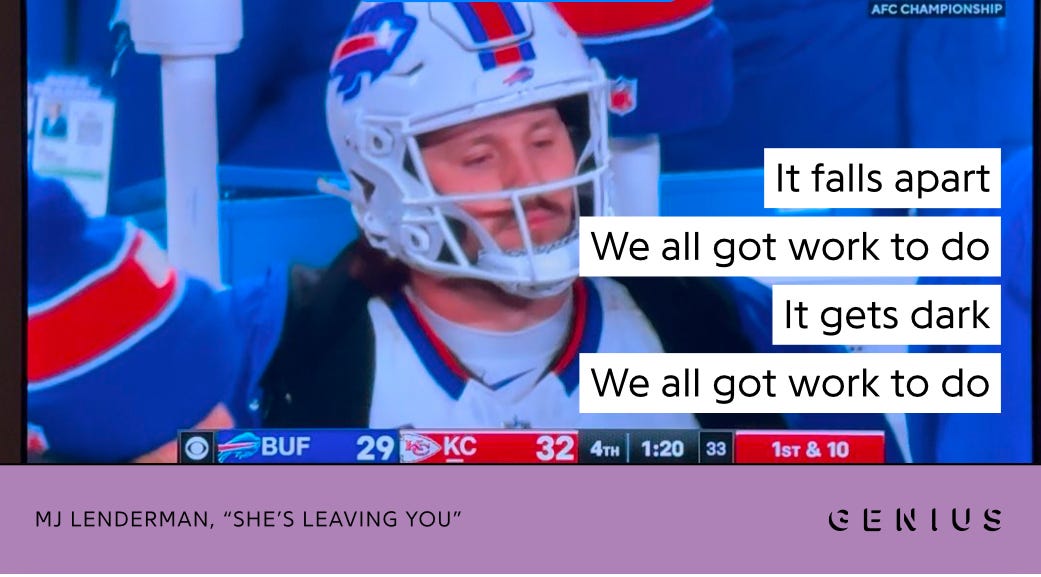
The Buffalo Bills' season ended last week, and ended as it has four of the past five seasons, in a loss to the Kansas City Chiefs. While the loss has produced in other fans a sense of impotent rage, or paranoid conspiracies that the league is out to get them, this latest loss made me feel only a bone deep sense of existential futility. No matter what happens, play well, play poorly, play at home, play on the road, lead late, trail late, it all ends the same, and a future of it ending the same stretches out ceaselessly in front of me. It’s enough to make one turn to Beckett, pull up their favorite emo anthems of the 2010s (I had a chance to construct something beautiful / And I choked, I choked / I choked, I choked!!!), and simply wallow in the cold, indifferent universe.1
But 31 teams fall short of a championship every year, and even a week out, I can begin to look back fondly on the season that was; watching your team lose in the playoffs every year is a different kind of pain than watching them miss the playoffs entirely for seventeen straight seasons, and having experienced them both, well, at least the former includes a whole lot more winning in general. I got to see some incredible things this season: Josh Allen somehow throwing and catching a touchdown on the same play in a blizzard; James Cook scoring three touchdowns against the Dolphins, including a long run on a perfectly blocked Duo concept; a maligned kicker hitting a 61 yard field goal to beat the Dolphins (again); two straight 40 point games against the Rams and Lions (one of those in person in incredible seats thanks to a good friend in LA); a game saving forced fumble in the playoffs; this sweet catch. But beyond these tears-in-the-rain type highlights, this football season also got me to buy a little book that is now a cherished part of my library, though it’s a bit oblique how one thing connects to the other.
For somewhere around two decades, a friend of my dad’s has been running a football picks competition - a so called ‘confidence’ pool - among family and friends. It’s important to note that absolutely no money is at stake here, just bragging rights in the form of your picture on the pool website for a year after you win.2 In the past couple years, I’ve started getting my own football-loving friends into the pool, giving us a nice diversion from fantasy football and sports gambling; the only thing that matters in the pool is whether you know ball or not, and whether you can remember to get your picks in on time. (The NFL played a game on every day of the week except Tuesday this season, so it can be tough to keep up with.) Since I was the one who got my friends into the pool, I figured I should also be the one to remind them to make their picks, as forgetting a week will basically sink you. At first, my reminder texts were simple, and to the point: every Thursday morning, I’d send a message along the lines of ‘don’t forget your picks, lads’ and then go on with my day.
In the long buildup to this last season, though, I thought I could do better. I’m not sure what prompted me to think of this – it’s perhaps just how my stupid brain works – but I wondered if the message could be dramatized in a way to convey its urgency, and so, I thought, as one does, of Kafka. A classic Kafkan formulation is that of the hoped-for message either never being sent or never being delivered; the word (or the Word) that would save you is always just around a corner you’ll never reach. It was easy enough to grab “An Imperial Message” and tweak a couple words here and there and make it about a man traveling through an endless procession of obstacles to deliver the news that you need to get your picks in before the season opener. The resulting four to five emoji reactions to that message was enough to make me want to do it the next week, and once I’ve started a bit it’s pretty difficult to give it up. Problem was, the NFL season is eighteen weeks long, and after a month or two I had scraped the barrel of all the literature I could think to pilfer. That included some more Kafka (“Before the Law” became “Before the Picks,” and I burned “Give It Up!” by accidentally sending it a day early), the apocryphal Ernest Hemingway ‘saddest story ever written in six words’ (‘He forgot to make his picks'), a bit of Tolstoy (a long rendition of the three pickers), and a couple selections from what I’d call ‘the internet canon of flash fiction,’ the stories that have been aggregated on enough websites to consistently come up when you google ‘best microfiction.’ These include George Saunders’s “Sticks” (easy to get the stick man in a jersey), Margaret Atwood’s “Widow’s First Year” (only four words, more of a visual joke) and Hemingway’s “Chapter V,” but at a certain point I was starting to run out of easy solutions. There are only so many ways to jam ‘don’t forget your picks’ into a limited set of stories, and I’d die before I let some A.I. bot help me in this quest. In desperate need of material, I did what I always do in times of extremity: I bought another book.
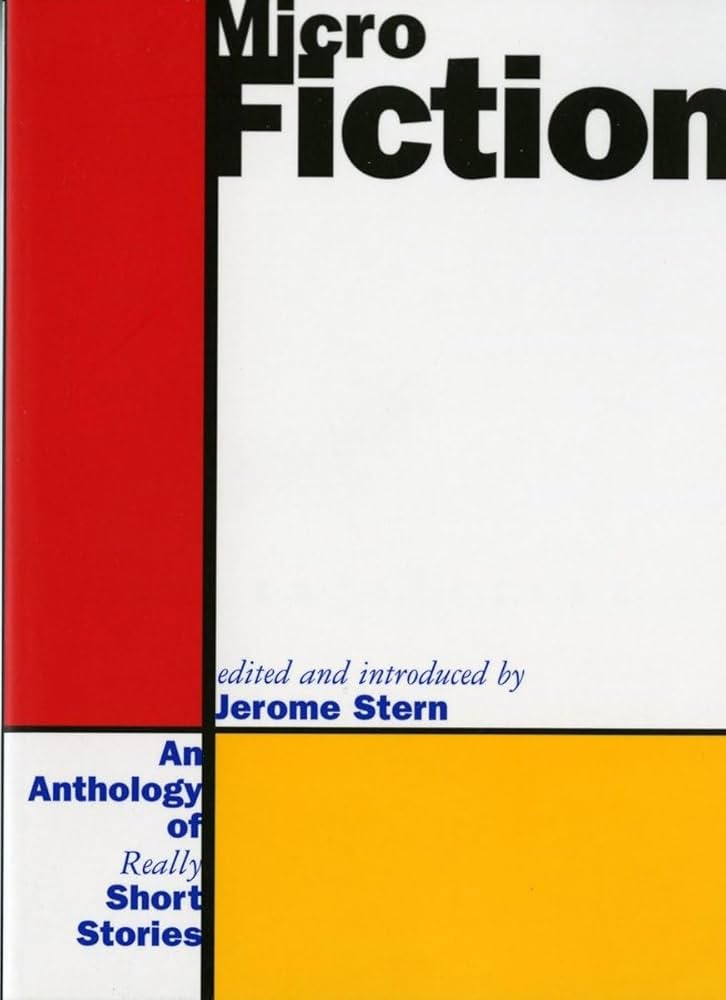
My search for stories had brought me upon Jerome Stern’s anthology Micro Fiction: An Anthology of Really Short Stories, and the online preview of the table of contents promised untold bit riches – stories by Amy Hempel, Ron Wallace, and Stuart Dybek, plus many more, all waiting for my stupid tweak. Once the book arrived (special order from my local, of course), flipping through this little book of 50some stories on Wednesday night and Thursday morning became a cherished ritual. Whether the stories worked for the bit or not, the riches of the collection slowly revealed themselves to me.
In 1986, Jerome Stern, an English professor at Florida State, began collecting entries for what he called the World’s Best Short Short Story Contest. Entries were capped at 250 words, and the prize was 100 bucks and a crate of oranges. Micro Fiction collects ten years of winners and finalists from the competition, as well as some commissioned stories (with the limit upped to 300 words) from some friends of the program; Stern died in 1996, but made his last picks for the contest and the collection before it published. As Stern explains in his introduction, “the short short story is not exactly a novelty, or form that is entirely experimental. Nor is it an artificially constricted orifice through which the writer is asked to squeeze.” What Stern was after with the 250 word maximum was simply the limits of one printed page; just like any game, you mark the lines arbitrarily and see what happens within them.
There isn’t much middle ground among the stories; you either go one sentence (Amy Hempel’s “Housewife,” and “Hostess” isn’t much longer) or take the whole 250-300. A story this short requires an immediate conceit, a couple rounds of escalation, and then a graceful exit; there’s no way to ease your way in and out obliquely (as some of the best short fiction writers do.) These are stories winnowed down to their most essential parts, divested of the demands of characterization and tone and instead zeroing in on incident and resolution. The mix of writers veers between giants (although Lydia Davis and Diane Williams, two masters of the genre, didn’t deign to enter, or at least no one asked) and the lesser known, so, like some kind of talent show, there is a particular pleasure in seeing each contestant enter the ring, whether you know the name or not. Joy Williams, who now writes extensively in this form but didn’t 30-odd years ago, gives an early glimpse of her proclivity for the genre in “Harmony,” which begins with this setup:
June brought a friend when she went to visit her mother, who was dying. Her friend had never even met her mother, she just happened to be in town. June felt despicable, but she was terrified.
In only ten more sentences, Williams manages to stage one of her typical off-kilter moments of grace. (I’m loath to quote more, since that’d be the whole story!) That story is followed immediately by “20/20” by Linda Brewer, whose capsule biography in the back simply states that she was once a finalist in the competition. “20/20” is precisely structured, winding out elegantly from its setup:
By the time they reached Indiana, Bill realized that Ruthie, his driving companion, was incapable of theoretical debate. She drove okay, she went halves on gas, etc., but she refused to argue. She didn’t seem to know how.
Stick in the car and you get something like Sam Shepard’s “Guadalupe in the Promised Land”, which begins with a bang:
Guadalupe hit the skids and fishtailed into a ditch, crawled out of the wreck bleeding from the neck, saw the moon, laid his head in a mud puddle, said “Todo el Mundo” three times and snuffed out.
I’m focusing on beginnings, and want to quote some endings, which I think just means that the short short story basically eliminates middles, those tricky connective parts that mire many a story. Stripped down to their barest essentials, these stories still can mine deep emotional responses; they are minimalist machines of readerly pleasure. Stern’s own submission to the collection sees its narrator facing a terminal diagnosis, and ends sweetly on the lines:
So my wife and I drive to the giant discount warehouse. We sit on the floor like children and, in five minutes, pick out a 60-inch television, the largest set in the whole God damn store.
It’s somehow, after only 200some words, a stirring kind of carpe diem, one of many of the little gems in this collection that stick with you longer than stories twenty times as long and novels five hundred times as long; that’s the little miracle of this little book. The Super Bowl’s coming up this weekend, and I’ll likely find myself in front of the largest God damn set I can find to watch it, no matter how personally distressing it might be for me to see, and yes, I’ll make sure everyone gets their last pick in. It’s only seven months till the next Bills game, till the next long setup to disappointment, but at least I’ve got a good book to turn to, over and over again, a companion for many cold off-seasons to come.
You can (and should) get Micro Fiction: An Anthology of Really Short Stories at your local bookstore, local library, or online at Bookshop.org, where purchases benefit independent bookstores across the country.
If you liked this post, please share it with a friend! And if you know any good short stories to wedge ‘don’t forget your picks in’ into, let me know.
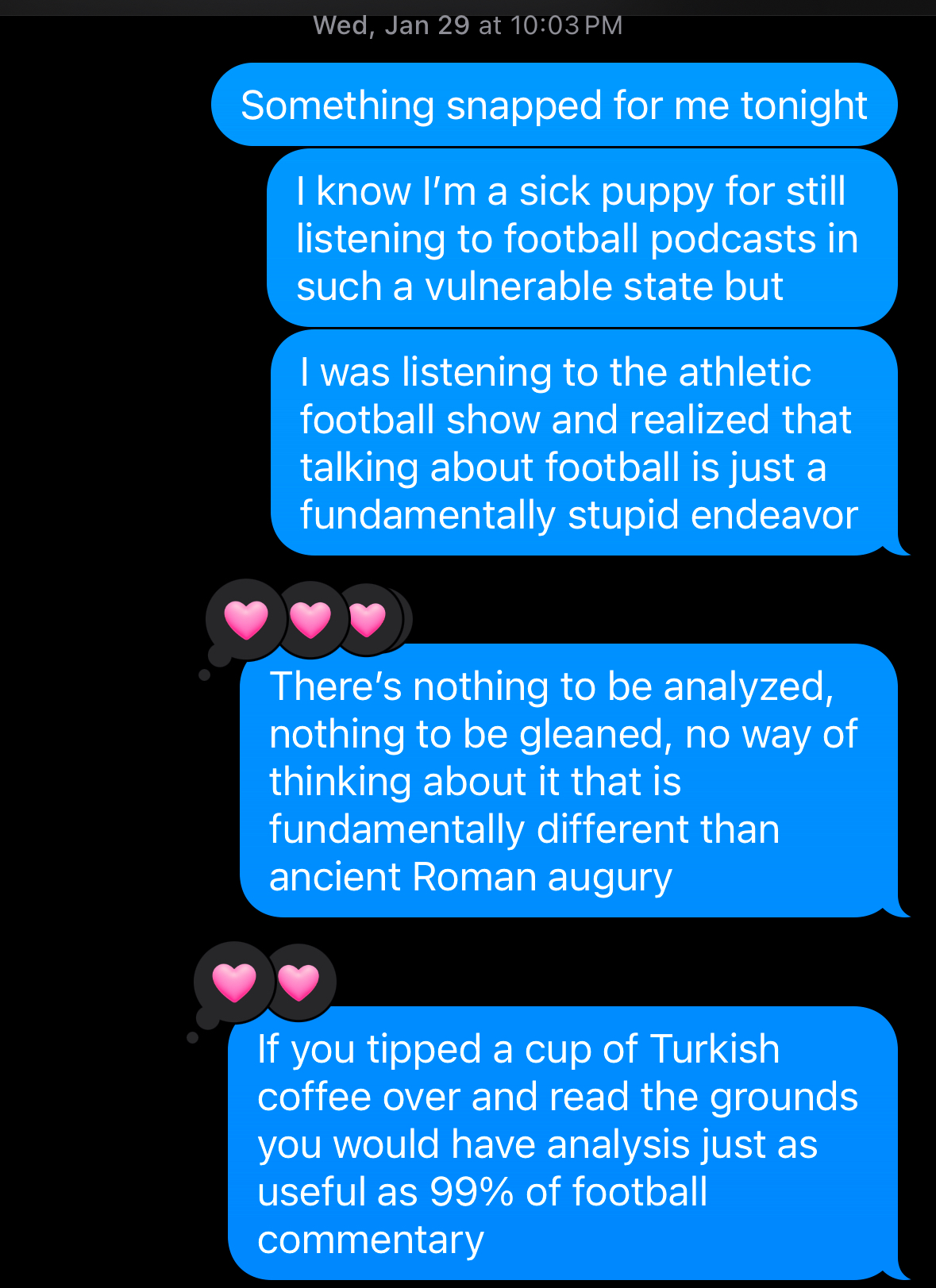
How I processed it three days later.
It’s also important to note that my wife won rookie of the year in the pool this past season.
As a lifelong Broncos fan you’ll find no solace from me, but at least we can share in our mutual hatred for the Chiefs (also, this collection sounds great).